
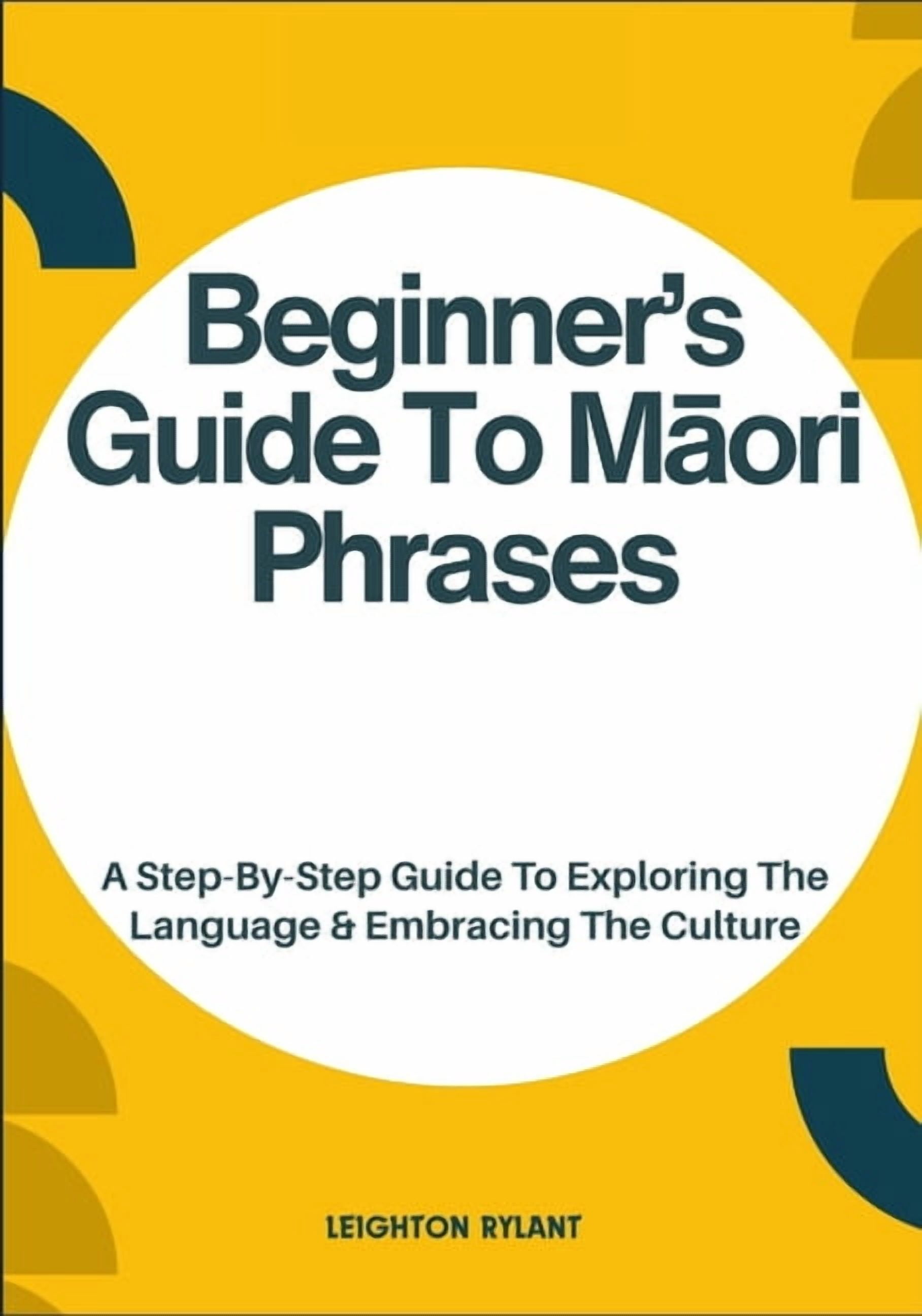
Beginner's Guide To Māori Phrases: A Step-By-Step Guide To Exploring The Language & Embracing The Culture, (Paperback)
Product details
| Management number | 240756114 | Release Date | 2026/07/16 | List Price | US$4.40 | Model Number | 240756114 | ||
|---|---|---|---|---|---|---|---|---|---|
| Category | |||||||||
The M&#257;ori people, the indigenous Polynesian inhabitants of New Zealand, speak M&#257;ori as their native language. It is one of the official languages of New Zealand, in addition to English and New Zealand Sign Language. Te reo M&#257;ori, or M&#257;ori, is a significant component of New Zealand's identity and has a complex cultural and historical significance.<br><b>Key Features of M&#257;ori Language: </b><br>- <b>Phonetics</b>: M&#257;ori has a relatively simple phonetic system compared to many European languages. It contains 15 letters in total-five vowels (a, e, i, o, u) and ten consonants (h, k, m, n, ng, p, r, s, t, w).<br>- <b>Vowel Sounds</b>: Vowels are crucial in M&#257;ori because each one can have a short or long sound, which can change the meaning of words. Long vowels are represented with a macron (&#257;, &#275;, &#299;, &#333;, &#363;).<br>- <b>Pronunciation</b>: M&#257;ori pronunciation is fairly straightforward once you get the hang of it, as the language is phonetic. For example, <i>wh</i> is pronounced like an English "f" (e.g., <i>wh&#257;nau</i> = "family").<br>- <b>Word Structure</b>: M&#257;ori is an agglutinative language, meaning that it often uses prefixes and suffixes to modify the meaning of words. This structure can make sentences look a bit longer than their English counterparts.<br>- <b>Articles</b>: M&#257;ori has a system of definite and indefinite articles, similar to "the" and "a" in English: <ul><li><i>Te</i> (the) for singular, definite nouns</li><li><i>He</i> (a) for singular, indefinite nouns</li><li><i>Ng&#257;</i> (the) for plural, definite nouns</li></ul>- <b>Sentence Structure</b>: The typical sentence order in M&#257;ori is VSO (Verb-Subject-Object). This is different from English, which generally follows a Subject-Verb-Object (SVO) order. For example, "I eat an apple" in M&#257;ori would be "Ka kai au i te &#257;poro."<br>- <b>Cultural Context</b>: M&#257;ori is deeply intertwined with the culture, traditions, and worldview of the M&#257;ori people. Many M&#257;ori words, phrases, and concepts cannot be fully understood outside of this context. This makes learning the language not just about the words themselves but also about the culture behind them.<br><b>Examples of Basic Phrases in M&#257;ori: </b><ul><li><b>Haere mai!</b> - Welcome!</li><li><b>T&#275;n&#257; koe</b> - Hello (to one person)</li><li><b>Kei te p&#275;hea koe?</b> - How are you?</li><li><b>Ng&#257; mihi</b> - Thank you</li><li><b>Aroha mai</b> - Sorry</li><li><b>E noho r&#257;</b> - Goodbye (when someone is leaving)</li><li><b>Haere r&#257;</b> - Goodbye (when you are le</li></ul>
- Beginner's Guide To Māori Phrases: A Step-By-Step Guide To Exploring The Language & Embracing The Culture, (Paperback)
- Author: Independently Published
- ISBN: 9798297261020
- Format: Paperback
- Publication Date: 2025-08-09
- Page Count: 80
| Book format | Paperback |
|---|---|
| Fiction/nonfiction | Non-Fiction |
| Genre | History |
| Publication date | August, 2025 |
| Pages | 80 |
| Subgenre | Australia & New Zealand |
| Series title | No Series |
| Number in series | 0 |
| Edition | 1 |
| Publisher | Amazon Digital Services LLC - Kdp |
| Original languages | Mori |
| Language | English |
| Edu focus | Languages |
| Is collectible | N |
| Recording time | 0 min |
| Retail packaging | Single Piece |
| Assembled product dimensions (l x w x h) | 7.00 x 0.17 x 10.00 in |
| Assembled product weight | 0.34 lb |
| Bisac subject heading | History |





Customers who viewed this product also viewed
Texas A&M Aggies Fan Shop


Correction of product information
If you notice any omissions or errors in the product information on this page, please use the correction request form below.
Correction Request Form